
• Home
    • About Us
    • Privacy Policy
  • Cleaning Services
    • Pressure Cleaning
    • Roof Cleaning
    • Deck Cleaning
    • Paint Stripping
    • Stone & Concrete Cleaning
    • Light Fixture Cleaning
    • Graffiti Removal
    • Property Maintenance
  • What Not To Do
    • Pressure Washing: What Not To Do
    • Decks: Common Mistakes
  • Step-by-Step Guides
    • Deck Stripping: A Visual Guide
    • Cedar House Restoration — A Visual Guide
  • Photo Gallery
    • Deck Envy Portfolio
    • Pressure Washing Photo Gallery
    • Roof Cleaning Photo Gallery
    • Stone Care Photo Gallery
    • Chandelier Photo Gallery
  • Blog
  • Contact Us

Connecticut Power Washing

Menu

  • Decks
    • Stripping
  • Power Washing
  • Pressure Washing
  • Roof Cleaning
    • Soft Wash
  • Stone Care
  • Welcome
  • What You Need To Know
Previous

Deck Stripping: What to Know About the Process

September 24, 2014 · by Diamond Jim's Pressure Cleaning

Pressure_Cleaning_Paint


I thought I’d expand some from an earlier post of eClean Magazine featuring our Deck Stripping: A Visual Guide photo gallery. So here’s some information for those of you considering having your existing deck stripped or, if you’re considering putting a finish on your deck, read this first to avoid having to have it stripped later.

Film forming finishes damage the wood. These types of finishes not only flake and peel off, but hide the fact that the wood is being damaged underneath them as they trap and hold water. You may not see it right away, but they start to fail in their first year because in Connecticut we have extremes of temperature that expands and contracts our wood in winter creating the cracks in the finish that let moisture in.

Stripping finishes off wood is a very difficult process. The chemicals used need warm weather to work their best and homeowners need to understand they may have to wait for those warm days to arrive before the job can be started. If it’s a new finish they want removed, we may suggest they wait a year, depending on what was applied. If many layers of finish are on the deck it may take a few applications to remove it. The stripping chemicals also need time to do their job. After we remove the bulk of the finish with a stripper, we apply a neutralizer to the wood to deactivate it. Then it’s time for sanding and buffing, sometimes with large floor machines. Oftentimes we have to set the nails or screws in lower to be able to use these resurfacers. Lastly an oil preservative is used.

We never put a film forming finish on decks. We’ve spent too many hours restoring wood decking to it’s natural beauty to ruin it with paint, acrylic sealers, etc. After we bring these older decks back down to the wood, we treat them with oil preservatives. And here is another area where we may differ from many companies. We will apply the oil to the deck until the wood cannot hold anymore. We do this because it’s the oil in the wood that keeps out the water which will rot, crack and cup your boards. That’s why some of the decks we maintain are 25+ years old and are still beautiful. Using this much oil brings the cost of materials up on a job which may make us more expensive upfront, but less when it’s time to do a future deck maintenance.

What to take into consideration when stripping your deck.

First, when you get quotes from companies, they should do a test spot to see what stripper will work best. Lately we’ve been using an environmentally friendly stripper and we’ve been very happy with the results. But different strippers are for different products and someone with experience in the business will be able to choose the right one for best results on your deck. And by all means, if you know what was applied to your deck and how long ago, let them know. The test spot also helps them judge how many coats of finish are on the deck. This is not full proof, as painter’s have a bad habit of overlapping product or even using paint as a filler in uneven boards. Sometimes there are more coats on some areas of the deck then others and there’s no way to know that with just one test spot, after all, we can’t put twenty test spots on your deck.

After the test spot the company should be able to give you an idea of how much finish can be removed. Sometimes, as with paint, the very deep cracks in the wood will still have some paint in them after it’s stripped. A lot of that depends on the grain in your wood. Most of that will work it’s way out during the first year as the oil that’s applied will loosen it from underneath. But that is where you as a homeowner has to be patient as some things just take time.

Second, ask what finish is to be put on, it should be an oil preservative and they should be able to tell you about how much oil your wood will take. Some woods like Ipé will barely take any (but that’s another post) where others take gallons upon gallons. The key here is to make sure the company is going to apply enough oil to preserve the wood and not just color it. Color can be worn off, but even if it is, as long as a deep application was made, the oil is still in the wood preserving it. A year or two later a maintenance coat of oil can always be applied after a cleaning to make the color pop again.

And lastly, decks need to be maintained, once you go through the effort of restoring a deck, you should have the company come back every couple of years to clean the deck off and put a light coat of oil on it to keep it beautifully preserved.


Here you can see the excessive layers of paint that are being stripped. Sometime clients may want miscellaneous things like the flower pot in the background stripped. However, that pot was rotted out from the inside and it is cheaper to replace it than strip it with unsatisfactory results. Some jobs have spindles where it's more effective to replace them then try to strip them also.
Here you can see the excessive layers of paint that are being stripped. Sometime clients may want miscellaneous things like the flower pot in the background stripped. However, that pot was rotted out from the inside and it is cheaper to replace it than strip it with unsatisfactory results. Some jobs have spindles where it’s more effective to replace them then try to strip them also.
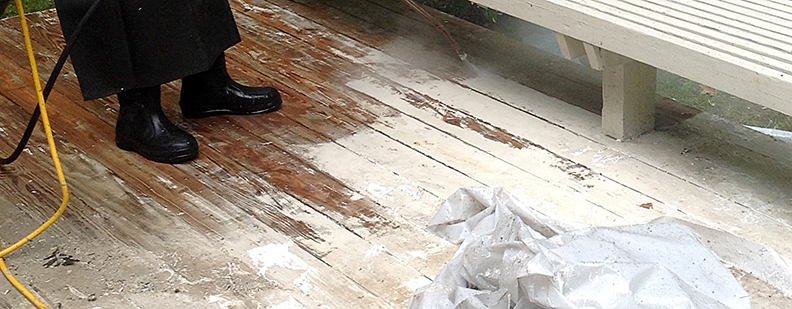
Here you can see what the stripper was able to remove and what is left to remove mechanically.
Another photo after the stripper did it's job. There's still sanding and buffing to do here.
Another photo after the stripper did it’s job. There’s still sanding and buffing to do here.
During sanding and buffing. Most of the finish is gone. There will be however a certain amount in the deep cracks that will have to loosen with time as the oil applied seeps under it. We had recommended the benches in the back not be stripped as it's nearly impossible to get the paint out between the top strips of wood. However the client insisted against our better judgement.
During sanding and buffing. Most of the finish is gone. There will be however a certain amount in the deep cracks that will have to loosen with time as the oil applied seeps under it. We had recommended the benches in the back not be stripped as it’s nearly impossible to get the paint out between the top strips of wood. However the client insisted against our better judgement.
The deck had been stripped, sanded and buffed. We are now applying an oil preservative to it. The deepest cracks will have some paint still remaining. The dark oil will make those areas more apparent, but that will tone down after about a month and get even better over the year and with timely maintenances.


Share this:

  • Click to share on X (Opens in new window) X
  • Click to share on Pinterest (Opens in new window) Pinterest
  • Click to share on Facebook (Opens in new window) Facebook
  • Click to print (Opens in new window) Print
  • Click to email a link to a friend (Opens in new window) Email
Like Loading...

Related

Posted In: Decks, Power Washing, Pressure Washing, Stripping, What You Need To Know

Comments

Leave A Comment →

Leave a comment Cancel reply

  • Categories:

    Decks Power Washing Pressure Washing Roof Cleaning Soft Wash Stone Care Stripping Welcome What You Need To Know
  • Tags:

    Algae Bleach decks diamond jim Eco-Green exterior maintenance Gloeocapsa magma Lichen light brown oil Low Pressure Moss No Pressure roof decks Roof Shingles Sodium Hypochlorite Soft Wash stripping
  • wordpress blog stats
  • Latest Tweets

    Tweets by ipressureclean
  • Blog at WordPress.com.
  • Connect with us:
  • Twitter
  • RSS
  • Comment
  • Reblog
  • Subscribe Subscribed
    • Connecticut Power Washing
    • Already have a WordPress.com account? Log in now.
    • Connecticut Power Washing
    • Subscribe Subscribed
    • Sign up
    • Log in
    • Copy shortlink
    • Report this content
    • View post in Reader
    • Manage subscriptions
    • Collapse this bar
 

Loading Comments...
 

    %d